Just a quick note, I went over the code base for the new covid app. There's some issues with it e.g. lack of tests and some code quality issues that you'd probably find in any app but from a data privacy and security point of view it looks good.
Honestly we should make open sourcing of new government apps mandatory, it's amazing to be able to audit something like this and trust that it's doing what they say it's doing. I really don't think I could have used something like this without this level of transparency.
Highly recommend anyone who hasn't already download the app, the more people who use it the better it will work.
App:
https://covidtracker.gov.ie/
Code:
https://github.com/HSEIreland
Wednesday, 8 July 2020


Wednesday, 4 January 2017
SailBike Dublin probaby my last Sailfish app
 In the recent Haapajoki 2.0.5.6 Sailfish update, certain location and mapping APIs were removed. This had consequences for several apps but specifically it broke BikeMe, the app which I was using to check whether there was bikes available on the dublin bikes scheme. I'm sure this will be fixed soon by the author of BikeMe as there has been regular updates to the app but as I use dublin bikes on a daily basis I needed a replacement.
First, I looked at "CityBike'me" but unfortunately the dublinbikes datasource appeared to be broken in this app so I decided to roll up my sleeves and write my own. I thought that since BikeMe would be fixed soon enough. I'd only need something simple for my own needs and MVP to get through the time while BikeMe wasn't working. So I found an API to use and decided I just wanted a list of stations with how many bikes/spaces were available with a quick station view to how extra information like how old this information was and the location on the station on a map.
A couple of hours, hacking about later I came up with SailBike Dublin, screen shots and a link to the github repo can be seen below. It's very much a stop gap but hopefully it helps a few other people out as well, I've released it on the Jolla harbour it'll be up as soon as it's passed QA. As with all software which I release opensource, it's MIT licensed. If anyone needs one for their city, let me know. It's fairly trivial to make a version which isn't Dublin specific.
Unfortunately as I've recently dropped my Jolla (cracking it's screen) and missed out on the Jolla C device program this will most likely be my last app for Sailfish OS. Unless of course, the program reopened before I end up replacing my Jolla with an Android phone.
Github: https://github.com/ShaneQful/SailBikeDublin
Screenshots:


Friday, 13 May 2016
Recovering my Jolla from a boot loop
 Recently while I was updating my Jolla phone to the latest release. I was asked to optimize the space left of the disk before updating. I did this but my phone got powered off during this process and once it was charged again it went into a bootloop. That is to say that it booted with the Jolla logo and then went to a blank screen and never went further.
Upon investigating the issue, I found that the Jolla file system is btrfs and that it was during a btrfs operation the device got turned off causing some file system issues. I read over Jolla's instructions on how to reset the device to factory settings available here but I didn't want to reset my device as it had quite a bit of valuable data on it. Luckily they had instructions on how to recover that data available here. These instructions worked for getting data off the device although it took several trips due to the size of my SD card. As an aside always have a backup .vault file on your Jolla it will make this process easier , I didn't and I wonuld have had to write code to retrieve my contacts and message from SQLite DBs had I not been able to fix the device.
Once I had my data safely off the device, I wanted to remove some of it to attempt a btrfs recovery. In order to see if I could get the device back in working order without a factory reset. However the file system which I had mounted using the instructions in the article wasn't writable so I couldn't delete any data. Eventually I found that I could mount the file system like so
Which mounted the file system as writable, I then removed my Videos folder as it was safely backed up and would remove 2GB of space form the device. Then I ran sync and umount commands to make sure it was gone and to unmount the file system. Once I had done this I used option 5 in the recovery console to attempt a btrfs recovery and then I rebooted the device, it took a little while longer than usual to reboot but it's now back to normal and working as expected.
I hope this helps anyone else experiencing similar issues.
Wednesday, 4 May 2016
Using GPG as a Last Pass Alternative
I use Last Pass on my laptop but have recently been thinking of moving away from it. There have been several reasons for this e.g.
My solution is a simple one, since all of my devices have a command line with gpg installed just use gpg to encrypt my passwords. I can then sync this encrypted file between all of my devices. Below you can see how to do this, in case it's something your thinking of doing yourself:
- Breaking accessibility in my browser
- Lack of secure clients for some of my devices (Sailfish OS & Ubuntu Touch)
- I wish they were open about their algorithms
My solution is a simple one, since all of my devices have a command line with gpg installed just use gpg to encrypt my passwords. I can then sync this encrypted file between all of my devices. Below you can see how to do this, in case it's something your thinking of doing yourself:
Sunday, 1 May 2016
uRoku for Ubuntu Touch
I've just released the first version of uRoku, a Roku remote app for Ubuntu Touch. It gives the user a remote interface along with a keyboard and the ability to launch Roku apps from their Ubuntu device. It's written using the Ubuntu Cordova SDK because the QML SDK won't work on Ubuntu 14.04. I may re-write it in QML later. It's MIT licensed and available on github and the Ubuntu app store now.
Github: https://github.com/ShaneQful/uRoku
uApp Exploerer: https://uappexplorer.com/app/uroku.shaneqful
Screenshots:


Github: https://github.com/ShaneQful/uRoku
uApp Exploerer: https://uappexplorer.com/app/uroku.shaneqful
Screenshots:


Thursday, 24 March 2016
Bash to audit your npm dependencies
With the issues surrounding npm today, I thought it would be interesting to write a bash one liner to see how many stars on github each dependency in my project's dependency tree has. The bash is below, it's only real dependencies are curl and npm. A word of warning, it does take quite sometime to run especially if you have lots of dependencies.
Gist: https://gist.github.com/ShaneQful/aa265f9ef87449b945b1
In regards to my opinion on the situation, the behavior of some of the individuals was clearly childish at best and everyone who was stung by the situation should be a little more careful about their dependencies.
npm ls | grep -oP "\w[^@]+@" | sed s/@// | sort |uniq | awk '{print "npm view " $1 " repository.url"}' | sh | grep -oP "github(\w|\W)+\.git" | sed 's/.git//g' | sed 's/.com/.com\/repos/g' | awk '{print "curl -s \"https://api."$1"\" | grep -P \"(stargazers_count|full_name)\" "}' | sh
Gist: https://gist.github.com/ShaneQful/aa265f9ef87449b945b1
In regards to my opinion on the situation, the behavior of some of the individuals was clearly childish at best and everyone who was stung by the situation should be a little more careful about their dependencies.
Saturday, 3 January 2015
"MerSDK" not starting ... enable VT-x in your BIOS
So I haven't updated my SailBusDublin app in a little while because my dev tools were broken. I was getting an error:
Error connecting to "MerSDK" virtual machine: Failed to start virtual machine "MerSDK"
At first I thought I haven't done anything other than update the tools and was a little annoyed at jolla for breaking them but then I came to my senses, people were clearly publishing apps on the store so it was probably an issue on my end.
I figured it was something easily fixable so did a little googling and couldn't find anything.This is not as weird as you might think given the size of the developer community so I decided I'd leave it a little while and someone else would run into the problem and fix it (the it's a side project and I'm being lazy approach) but alas while some people ran into it, no one seemed to fix it. So I decided to put the effort in and debug the issue.
It's fairly clear from that error that it's an issue with the VM so I opened virtual box rather than bother with QtCreator again and tried to start the VM and got an error about intel's VT-x which was weird because I didn't remember making any changes to my laptop in regards to virtualization. Anyway found some redhat docs on the issue:
https://access.redhat.com/documentation/en-US/Red_Hat_Enterprise_Linux/6/html/Virtualization_Administration_Guide/sect-Virtualization-Troubleshooting-Enabling_Intel_VT_and_AMD_V_virtualization_hardware_extensions_in_BIOS.html
and went into the BIOS and turned it back on and voila the "MerSDK" VM started and I was back up and running.
I think I turned it off at some point because of a security issue with VT-x but the only issue I can find of the subject can't be exploited on my laptop because it's 64-bit running a 64-bit host. That said if your running a 32-bit host be careful of the VM's you use if you re-enable VT-x.
Error connecting to "MerSDK" virtual machine: Failed to start virtual machine "MerSDK"
At first I thought I haven't done anything other than update the tools and was a little annoyed at jolla for breaking them but then I came to my senses, people were clearly publishing apps on the store so it was probably an issue on my end.
I figured it was something easily fixable so did a little googling and couldn't find anything.This is not as weird as you might think given the size of the developer community so I decided I'd leave it a little while and someone else would run into the problem and fix it (the it's a side project and I'm being lazy approach) but alas while some people ran into it, no one seemed to fix it. So I decided to put the effort in and debug the issue.
It's fairly clear from that error that it's an issue with the VM so I opened virtual box rather than bother with QtCreator again and tried to start the VM and got an error about intel's VT-x which was weird because I didn't remember making any changes to my laptop in regards to virtualization. Anyway found some redhat docs on the issue:
https://access.redhat.com/documentation/en-US/Red_Hat_Enterprise_Linux/6/html/Virtualization_Administration_Guide/sect-Virtualization-Troubleshooting-Enabling_Intel_VT_and_AMD_V_virtualization_hardware_extensions_in_BIOS.html
and went into the BIOS and turned it back on and voila the "MerSDK" VM started and I was back up and running.
I think I turned it off at some point because of a security issue with VT-x but the only issue I can find of the subject can't be exploited on my laptop because it's 64-bit running a 64-bit host. That said if your running a 32-bit host be careful of the VM's you use if you re-enable VT-x.
Saturday, 5 April 2014
Ubuntu One shutting down and what that means for the KDE plugin
 I have recently learned that Ubuntu One will be shutting down on June first, with data accessible for another 2 months after that. See Canonical's Post for more details ...
This is a little sad for me as I have enjoyed using the service and trusted Canonical with my data, a lot more than a great many other companies. So much so, that I wrote a plugin which allowed KDE users to access Ubuntu One through Dolphin. I intend to put an updated version of the plugin on the opendesktop.org which notifies users of this decision and I will pull the plugin on the first of June when the service goes down. The code will remain avaible under the MIT license on github if anyone wants to use it for their next cloud storage solution.
I want to thank all my users for being so nice when reporting feedback, be they bugs or compliments they were always polite and informed. I would also like to thank Canonical for a wonderfully reliable service and thank them for opensourcing the back-end now that they are shutting down said service.
I wish everyone the best of luck if finding a new cloud storage solution, I think I will be using this opportunity to switch to a service with client side encryption by default. I whole heartedly recommend others do the same.
Sunday, 23 March 2014
SailBus Dublin
Just a quick post to announce I've released an app for the new Jolla smart-phone. "SailBus Dublin" is a bus tracking app for Dublin city based off the National Transport Authority's new Real Time Information System(RTPI) API.
 It is free and open source, the code is available on github and bitbucket. I'll probably write a post in the future about how it all works but for the moment I'll just list a few of the features and say a big thank you to the National Transport Authority and Dublinked for giving me API access.
Features:
Features:
- Realtime information about bus arriving to stops
- Route information i.e. stops on a route
- Stop Location
Saturday, 22 February 2014
Making sites accessible one step at a time
There is a section of society that many of us as developers don't consider when making our applications, those who have a disability. We often represent information with colours or images not thinking of how it may affect a visually impaired user using a screen reader or unknowingly break the tab flow to make keyboard use of an application impossible.
I have the privilege of working for a company which only produces accessible applications but I would like this ethic to rub off on some of my personal projects.
In the next series of posts, I'm going to make my blog accessible and explain how I did it and what tools I used to do it hopefully giving insights for others into a how to make their applications accessible. In order to do this I will be making this site WCAG 2.0 compliant.
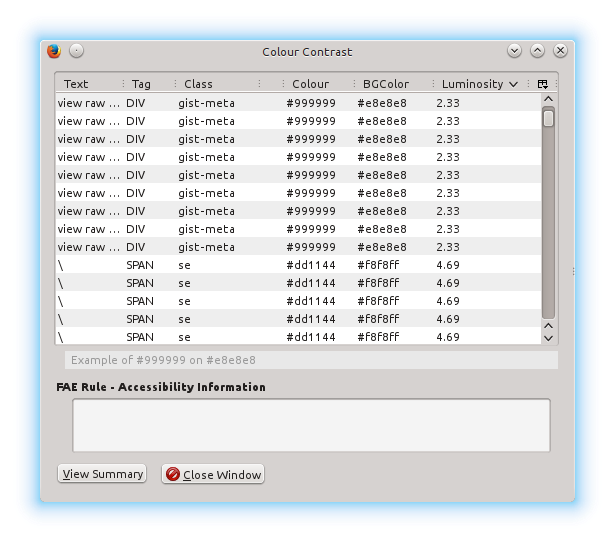 The first step in this process is to tweak the colour scheme of the site in order to be WCAG compliant. Which is to say, having a greater than 4.5 contrast between all text and it's respect background and make sure the link colour has a greater than 3.0 contrast with the surrounding text.
In order to find the issues with the site I used a firefox plugin, luckily once the issues were found it wasn't much work to fix them and the blog's theme by default was mostly accessible as only two pieces of text had to be changed to a darker colour. The main issue was the github gist iframe I use to display code snippets, unfortunately this had several issues with the area surrounding the code surface. In order to fix these issues, I hid the bottom bar and added CSS to darken the line numbers on the side. I'll have to add an attribution to github somewhere else in the site.
There you have it a small change which will help a certain demographic of visually impaired users to use my site more effectively. In my next post I'll be discussing keyboard usability.
I have the privilege of working for a company which only produces accessible applications but I would like this ethic to rub off on some of my personal projects.
In the next series of posts, I'm going to make my blog accessible and explain how I did it and what tools I used to do it hopefully giving insights for others into a how to make their applications accessible. In order to do this I will be making this site WCAG 2.0 compliant.
The first step in this process is to tweak the colour scheme of the site in order to be WCAG compliant. Which is to say, having a greater than 4.5 contrast between all text and it's respect background and make sure the link colour has a greater than 3.0 contrast with the surrounding text.In order to find the issues with the site I used a firefox plugin, luckily once the issues were found it wasn't much work to fix them and the blog's theme by default was mostly accessible as only two pieces of text had to be changed to a darker colour. The main issue was the github gist iframe I use to display code snippets, unfortunately this had several issues with the area surrounding the code surface. In order to fix these issues, I hid the bottom bar and added CSS to darken the line numbers on the side. I'll have to add an attribution to github somewhere else in the site.
There you have it a small change which will help a certain demographic of visually impaired users to use my site more effectively. In my next post I'll be discussing keyboard usability.
Saturday, 11 January 2014
Jolla - Review
So two days before Christmas my long awaited Jolla, a new smart phone created by the Finnish startup Jolla, arrived. First impressions were great, it was pretty, the battery lasted me more than a day and the android app compatibility seemed to work really well. Unfortunately due to the hectic Christmas season I didn't get to play with it very much but it did perform flawlessly in it's primary role as a phone.
 After new years and things had quieted down a bit in life, I started to play about with it more:
Music Issue:
I recommend you check out tracker-control on the command line it seemed to work for some people over at together.jolla.com. It only worked partially for me so I wrote a little bash to generate play-lists for artists which the indexer didn't pick properly.
Too fully understand this have a look at the PLS format it's not a very interesting read but if you ever want to create a PLS file without a media application it may be of some use.
Sound issue for Android Apps:
You need to become root using devel-su and then run this :
to restart the alien dalvik VM.
Source
MTP File Transfer Issues:
After new years and things had quieted down a bit in life, I started to play about with it more:- Setup email
- Install Humble Bundle for Android games
- Add more than just an album or two to the music library
- Use the Maps app
- Write software for the device (because this blog isn't called software on the side for nothing)
- etc ...
- Some music didn't get indexed properly and wouldn't show up in the media app
- Sound stopped working for android apps
- Camera didn't work for android apps
- MTP is a bit flakey(not sure if this is a Jolla problem or and issue with my Kubuntu install)
Music Issue:
I recommend you check out tracker-control on the command line it seemed to work for some people over at together.jolla.com. It only worked partially for me so I wrote a little bash to generate play-lists for artists which the indexer didn't pick properly.
Too fully understand this have a look at the PLS format it's not a very interesting read but if you ever want to create a PLS file without a media application it may be of some use.
Sound issue for Android Apps:
You need to become root using devel-su and then run this :
to restart the alien dalvik VM.
Source
MTP File Transfer Issues:
- SSH
- Rsync
- Ubuntu One for Android
- etc..
Monday, 22 July 2013
Ubuntu on the Edge of Success

My eyes have been glued to Canonical's crowd funding campaign, to create Ubuntu Edge. A top of the line limited edition smart phone packed with technologies everyone is too scared to ship. They are asking for a lot, 32 million dollars, in order to produce 40,000 incredibly awesome Ubuntu Touch devices. The specs of the devices are stunning:
- Fastest multi-core CPU, 4GB RAM, 128GB storage
- 4.5in 1,280 x 720 HD sapphire crystal display
- 8mp low-light rear camera, 2mp front camera
- Dual-LTE, dual-band 802.11n Wi-Fi, Bluetooth 4, NFC
- GPS, accelerometer, gyro, proximity sensor, compass, barometer
- Stereo speakers with HD audio, dual-mic recording, Active Noise Cancellation
- MHL connector, 3.5mm jack
- Silicon-anode Li-Ion battery
- 64 x 9 x 124mm
What's truly insane about this is that they not only have to break nearly every crowd funding record ever set in this attempt but they are on course to do so and then some. When I returned from work at 7:40 they were at about 770,000 dollars as I write this post at 22:10 they are at 1,430,000 dollars. That means in about four and a half hours they have raised 660,000 dollars at a rate of 146,666 dollars every hour. At that rate they will reach their goal in a little over a week.
That said I think some of this has to do with the first day offer of a $600 device instead of paying $800 dollars but it is never the less promising and if they hit their goal it will send shock-waves through both the software and mobile industries.
Saturday, 1 June 2013
Phone Gap's Build Service is Awesome
If you haven't heard of Phone Gap before it's a framework for turning HTML5 applications into mobile applications. I've used it before by downloading the SDK and building apps for both Android and iOS using mainly javascript with a small bit of native code. It's a pretty awesome piece of tech although it can tend to be a bit slow.
Today was the first time I used Adobe's Phone Gap Build Service and I have to say I was extremely impressed. Firstly it's free for opensource apps, it took maybe 2 minutes to setup, integrate with Github and suddenly I had an application targeting :

Today was the first time I used Adobe's Phone Gap Build Service and I have to say I was extremely impressed. Firstly it's free for opensource apps, it took maybe 2 minutes to setup, integrate with Github and suddenly I had an application targeting :
- Android
- Windows Phone
- Symbian
- Blackberry
- webOS
Monday, 27 May 2013
Jolla, Vivaldi what do think of Ubuntu ?
Just pre-ordered a new Jolla phone one of the successors to Meego and Maemo, who's devices I liked so much. It looks awesome and I can't wait to have proper Linux phone. Their launch is especially important for me due to a fall that caused the touch screen on my N810 to break and become almost unusable. Luckily the display itself still works just fine so I'll probably just use it in a hobby project or something.

So you'll probably see some Qt apps on the blog in the not to distant future. Hopefully targeting not just Jolla but Ubuntu Touch and KDE's Vivaldi Tablet. All these other platforms do have me a little worried. Mainly in regards to which one do I want to support or more to the point which one can I support since I won't have the money to buy all three devices not to mention a Firefox OS phone. I'm slightly scared the amount of emerging platforms at the moment may make it difficult for any one of them to even get the sort of community support that went behind the Nokia N900. I think the only way to make sure they survive is to buy the first that comes out and if I have the money and it's not to wasteful the second. Here's hoping the first is a phone and the second is a tablet.
There are several reasons these set of open platforms may stand a greater chance than those that came before:

So you'll probably see some Qt apps on the blog in the not to distant future. Hopefully targeting not just Jolla but Ubuntu Touch and KDE's Vivaldi Tablet. All these other platforms do have me a little worried. Mainly in regards to which one do I want to support or more to the point which one can I support since I won't have the money to buy all three devices not to mention a Firefox OS phone. I'm slightly scared the amount of emerging platforms at the moment may make it difficult for any one of them to even get the sort of community support that went behind the Nokia N900. I think the only way to make sure they survive is to buy the first that comes out and if I have the money and it's not to wasteful the second. Here's hoping the first is a phone and the second is a tablet.
There are several reasons these set of open platforms may stand a greater chance than those that came before:
- The main development platform is Qt and Qt is awesome, many of my favorite applications are Qt apps e.g. Skype, Kate
- If they sort out their SDKs they should be either compatible or easily portable. Meaning, if target all of them and some fail so long as one succeeds we as developers should be able to have a viable revenue stream regardless of which platform succeeds.
- The community is bigger and more organized, there seems to be more Linux users and r/linux pushes a lot more traffic than it used too.
Needless to say, I hope every one of these platforms succeeds but if they don't, I really hope at least one of these truly thrives. The real question is which platform the community and the public as a whole will get behind and which will succeed.
Saturday, 18 May 2013
Open Jog Alpha
I'm launching a new project in order to get me fit. It's called OpenJog although the name is pending review. It's a HTML5, Jquery Mobile Application to help joggers and other athletes stick to their training schedule. In particular it's helping me complete couch to 5k at the moment. The major features at the moment :
- Display of workouts which change as activities are completed
- Sound alerts for when you should switch activities
- Many more to come ....


I'll be working out it for the next little while as I want to release it for firefox OS. If anyone finds any bugs or other issues with it please let me know on the github issues page.
Monday, 1 April 2013
Android App Transaltion
Android has quite a nice system to allow translation and localization of apps. You store all your strings in an xml file abstracted from your code called strings.xml. You can then provide a different strings.xml for each language you want to support by storing the new strings.xml in a separate values folder. For example, if I translated an app to Irish, I would add a new values folder values-ga as ga is the two letter language code for Irish. Then I would place my new translated strings.xml into that folder.
Here's an example of how I added Irish language support to my Jupiter Broadcasting app
https://github.com/ShaneQful/Jupiter-Broadcasting-Android-App/commit/ff2d82609839f44915652bd9c98a49ab889e5bc5
As you may have noticed from some of my earlier posts. I'm a great believer in providing software, especially opensource software to users in their own language so I have created a form to allow users to easily translate the JB app to their native tongue.
https://docs.google.com/forms/d/1m7tkmIxdvCA9effm-_BAH1azW-EtwZWElOx7qlecchE/viewform
I also encourage anyone who would like to have a slightly more impressive Github profile to copy my example commit and send me a pull request with a strings.xml in a language which you know well*.
Another way to get involved in open source translation is to create a launchpad account and start translating your favourite project on launchpad. I myself have helped with the translation of Ubuntu's Unity and MojoSetup, an opensource cross-platform installer used by many Humble Bundle games, to the Irish language.
* Please don't just use Google translate I want the experience to be as good as possible for users.
Here's an example of how I added Irish language support to my Jupiter Broadcasting app
https://github.com/ShaneQful/Jupiter-Broadcasting-Android-App/commit/ff2d82609839f44915652bd9c98a49ab889e5bc5
As you may have noticed from some of my earlier posts. I'm a great believer in providing software, especially opensource software to users in their own language so I have created a form to allow users to easily translate the JB app to their native tongue.
https://docs.google.com/forms/d/1m7tkmIxdvCA9effm-_BAH1azW-EtwZWElOx7qlecchE/viewform
I also encourage anyone who would like to have a slightly more impressive Github profile to copy my example commit and send me a pull request with a strings.xml in a language which you know well*.
Another way to get involved in open source translation is to create a launchpad account and start translating your favourite project on launchpad. I myself have helped with the translation of Ubuntu's Unity and MojoSetup, an opensource cross-platform installer used by many Humble Bundle games, to the Irish language.
* Please don't just use Google translate I want the experience to be as good as possible for users.
Monday, 11 February 2013
KDE is awesome because it can be other DEs
KDE 4.10 was released a few days ago so I decided to tell people why KDE is my favorite desktop environment (DE). I was a Gnome 2 user. I loved Gnome 2.32, the last Gnome 2 release I used, it was fast configurable and generally pretty bad ass. These are the same reasons I like KDE except KDE is better because :
- It doesn't need compiz for fancy effects they're built in.
- It's the fastest desktop for gaming, even faster than xfce and lxde.
- You can basically make any of the other desktops using KDE.
- It is generally more polished than any of the other environments eg. you don't need to use the extra plugins like in Gnome3 but even if you want to they are built in to the menus in KDE. There's no need to go to a random website to download them.
KDE 4 Default:

Gnome 2:

Unity:


Wednesday, 6 February 2013
Diary Down, Diary Software based on Markdown
I have been writing diary entries for the last year as part of my project and for other projects. It's a great way of not forgetting anything and I highly recommend it if nothing else other than to keep you sane on larger projects. I have been doing this in markdown, which is an amazing little language to write in that converts to html.
 I had my diary in a git repo & scp'd the resulting html to a server every time I was finished writing so I could access the info anywhere. Eventually I wanted to index the entries so I wrote a little ruby script to generate a table of contents for me which worked great until I decided to over engineer the crap out of it now it's really awesome. In any case due to it's usefulness for me I decided to open source it so that it may be useful for others.
It requires:
markdown & ruby & a unix box (It probably won't work on windows)
Here's
An Example Diary
The Github for the project
The README on the github show's you how to use the diary. The git & scp stuff have been commented out but they are still in the code if anyone wants to use the features. Play around with the example, re-size the windows, use the key board shortcuts & hopefully you'll see this can be useful for you too.
I had my diary in a git repo & scp'd the resulting html to a server every time I was finished writing so I could access the info anywhere. Eventually I wanted to index the entries so I wrote a little ruby script to generate a table of contents for me which worked great until I decided to over engineer the crap out of it now it's really awesome. In any case due to it's usefulness for me I decided to open source it so that it may be useful for others.It requires:
markdown & ruby & a unix box (It probably won't work on windows)
Here's
An Example Diary
The Github for the project
The README on the github show's you how to use the diary. The git & scp stuff have been commented out but they are still in the code if anyone wants to use the features. Play around with the example, re-size the windows, use the key board shortcuts & hopefully you'll see this can be useful for you too.
Monday, 14 January 2013
Quick Command Line Tip
This is really just for me in case I forget but it should be helpful to others. The 'notify-send' can be used to send desktop notifications when your program has finished running. This is quite handy for long running commands that you might forget about like dding images or what not.
Friday, 11 January 2013
My Raspberry Pi Cluster :)
So my final year project is to make a cluster of raspberry pi micro computers to crack encrypted office documents and here is my pi cluster :)

The distributed document cracker is based on John the Ripper which I've already started to contribute to
- https://github.com/ShaneQful/npdf2john_ruby
- https://github.com/magnumripper/JohnTheRipper/blob/unstable-jumbo/run/pdf2john.py
I have a prototype for distributing John already built and while its not ready for public release everything made as part of this project will be open source once I feel the code is ready. (Probably under the MIT license)
Below is a gallery of how it got to this state. Sorry about the blurry images, I'm not a great photographer.
Below is a gallery of how it got to this state. Sorry about the blurry images, I'm not a great photographer.


Subscribe to:
Posts (Atom)